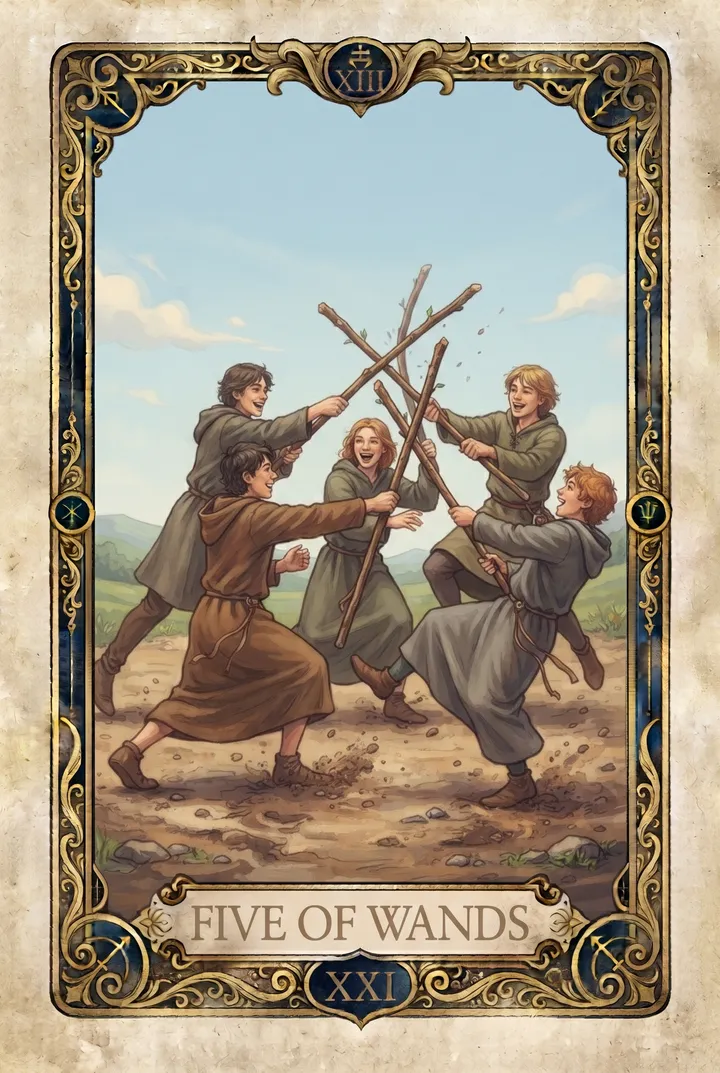
What it means
The Five of Wands is a Minor Arcana card in the suit of Wands, which is linked in tradition to Fire, action, drive, and instinct. As the number five, it often points to disruption, tension, and movement that has not settled into order yet. When this card appears, it usually describes a situation where several voices, ideas, or egos are competing for space.
In everyday life, that can look like coworkers talking over one another, siblings arguing about how to do a chore, or friends with different plans for the same weekend. The card does not usually point to a final winner, but to the clash itself. It asks you to notice where pressure is building, where energy is being scattered, and where a little structure could help.
History and tradition
In tarot tradition, the Five of Wands belongs to the suit of Wands, a suit associated with growth, initiative, ambition, and the spark that gets things moving. Wands often show fire in symbolic form, so this card is read as energetic, heated, and active rather than quiet or reflective.
Readers have long treated the fives in tarot as numbers of challenge or instability, and this card fits that pattern. According to tradition, it can describe rivalry, testing, disagreement, or the awkward stage where people are still figuring out roles. In modern tarot practice, many readers also see it as healthy friction, the kind that appears when ideas are being sharpened through debate.
You can think of it as the card of the crowded room, the practice match, or the brainstorming session that gets a little too loud before anything useful emerges.
How to read it
- Look at the setting around the card in the spread. If the other cards are calm, the Five of Wands may show temporary tension. If nearby cards are also sharp or fast, the conflict may be more intense.
- Notice whether the issue is outer or inner. It can mean real disagreement with other people, but it can also describe your own mixed motives, like wanting to speak up and also wanting to avoid trouble.
- Ask what kind of competition is involved. Is it playful, like a sports game or work brainstorming, or is it draining, like constant one-upmanship at home or online?
- Pay attention to the body language of the day. When this card appears, people may interrupt, rush, or defend their point too quickly. That detail often matters more than the topic itself.
- In a reading, connect it to the question. For work, it may point to deadlines, team friction, or proving yourself. For love, it may show a disagreement, a lively debate, or two strong personalities learning how to share space.
- If you read reversals, consider whether the conflict is being avoided, bottling up, or finally easing after a period of noise.
Meanings and key points
Upright
Upright, the Five of Wands often means competition, disagreement, lively tension, and the push to stand out. It is the card of five people trying to move at once, which can feel like a family trying to choose one restaurant when everyone wants something different. The energy is not neat, but it can be useful because it exposes what people really want.
In love, upright can show flirting with sparks, playful teasing, or an argument over small things that points to bigger differences in style. In work, it can show brainstorming, rival ideas, or pressure to prove yourself in a group. A common example is a team meeting where everyone has an opinion, and the best path only appears after a bit of noise.
Reversed
Reversed, the Five of Wands often suggests that conflict is being suppressed, avoided, or tiring everyone out. Sometimes the shouting has already happened, and now there is an awkward quiet where people are pretending nothing is wrong. Other times, it can mean the opposite, a step toward compromise and less needless drama.
In love, reversed may point to someone backing away from arguments or refusing to engage. In work, it can show a team that is finally lowering the volume and deciding who does what. Picture a shared project where two people stop competing for credit and start dividing the tasks clearly.
The heart of the card
At its core, this card is about friction that can either scatter energy or sharpen it. Not every clash is a disaster, and not every disagreement is useful. The key question is whether the tension is helping you see the truth of the situation, or just keeping everyone busy while nothing gets resolved.
Questions to ask yourself
- Where in my life does everyone seem to want a different outcome?
- Am I in a useful debate, or in a cycle of proving myself?
- What is the real issue under the noise?
- If I step back for a moment, what becomes easier to see?
Good to know
This card is part of tarot as a reflective and symbolic tradition, not a scientific system. Readers interpret it as a picture of conflict, rivalry, or lively group energy, but it does not predict events with certainty. If a situation involves serious stress, safety concerns, legal trouble, or mental health struggles, turn to the right professional support as well.
Frequently asked questions
What does the Five of Wands mean in tarot?
It usually points to tension, competition, disagreement, or a lively clash of ideas. The card often shows a situation where several people or motives are pulling in different directions at once.
Is the Five of Wands a bad card?
Not necessarily. It can feel uncomfortable, but it also brings out differences that need attention. In some readings it shows healthy rivalry, active discussion, or the pressure that comes before better structure.
What does the Five of Wands mean reversed?
Reversed, it often suggests conflict being avoided, cooled down, or quietly worn out. It can also show a move toward compromise, especially when people are tired of arguing and ready to sort things out.