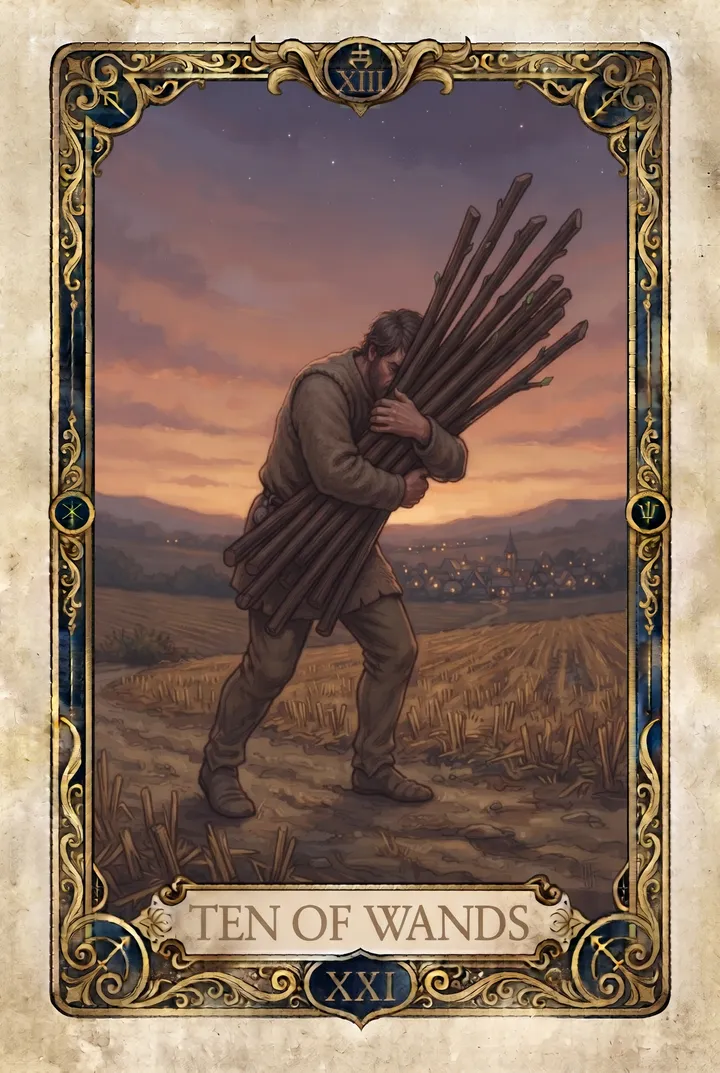
What it is
The Ten of Wands is a Minor Arcana card in the suit of Wands, and in tarot tradition Wands belong to the element of Fire. As the number 10, it often marks the end of a cycle, and here that ending comes with weight, effort, and pressure. This is the card you might feel on a day when your phone is buzzing, your bag is too full, and even small errands start to feel like one more thing on a long list. In readings, it usually points to responsibility that has grown large, sometimes by choice and sometimes because you kept saying yes. It can show pride in what you carry, but also the strain of carrying too much for too long.
History and tradition
The tarot developed as a card system in Europe, first as a game and later as a tool for symbolic reading. The suit of Wands is tied in tarot tradition to fire, movement, drive, work, and the energy that pushes projects forward. Within that system, the Ten of Wands is the final number in the suit, so it often represents the point where ambition meets limit. Readers and teachers of tarot commonly describe it as the burden card, but not in a purely negative way. It can also show commitment, persistence, and the kind of effort that gets a job finished when others have already stopped.
In practical readings, it is often taken as a sign to notice what you have agreed to carry. That might be a work deadline, family duties, a packed calendar, or the quiet habit of taking on what nobody else wants to touch.
How to practice it or how to read it
- Look at the card as a snapshot of load. Ask what feels heavy right now, a task, a role, a promise, or a schedule that has too many moving parts.
- Notice whether the burden is chosen or inherited. You may have taken it on willingly, or you may have drifted into it because you are the person who usually handles things.
- Read the card in context. In a love reading, it may point to emotional labor or a relationship that feels effortful. In a work reading, it may point to deadlines, overcommitment, or carrying a team project almost alone.
- Check for the finish line. The Ten of Wands often appears when the end is close, so the question is not only what is hard, but what still needs to be completed.
- If reversed, look for release, avoidance, or collapse. It can suggest dropping responsibilities, but also refusing to face what has piled up.
Meanings and key points
Upright Ten of Wands
Upright, the card shows burden, duty, persistence, and a heavy sense of responsibility. In love, it can look like one person doing most of the emotional work, such as remembering birthdays, smoothing over tension, and keeping the relationship moving while feeling tired inside. In work, it often points to a stretched schedule, a manager who keeps adding tasks, or a project that looked manageable at first and then grew legs.
The upright Ten of Wands does not usually say the task is impossible. It says the load is real. Think of carrying grocery bags from the car in one trip because you do not want to come back out, then realizing halfway up the stairs that you should have made two trips. The card has that same feeling, effort mixed with self-imposed pressure.
Reversed Ten of Wands
Reversed, the card often points to release, burnout, avoidance, or a decision to stop carrying what is no longer yours. In love, it can suggest pulling back from overgiving, or finally naming a pattern where one person has been doing too much. In work, it may show delegation, cutting a project down to size, or a moment when you realize that working harder is not the same as working well.
It can also show the opposite problem, dropping responsibilities too soon or leaving others to cover the gap. Picture a shared house where one person keeps pretending the bins are not full. Reversed, the Ten of Wands can be the moment the mess cannot be ignored any longer. It asks what can be put down, what must be faced, and what no longer deserves your energy.
The key message of the number 10
Ten is a completion number, so this card often appears when a cycle is near its end. That does not mean rest arrives instantly, but it does mean the weight has a shape and a limit. The end of a project, a season, or a role may be close, even if you are tired enough to miss it.
A useful everyday example is the last week before a big move, when the apartment is full of boxes, tape, labels, and half-packed drawers. The job is messy, but it is temporary. The Ten of Wands often carries that kind of energy, final effort before a release, not endless struggle with no exit.
Questions to ask yourself
- What am I carrying that no one has actually asked me to carry?
- Where am I saying yes because it feels easier than explaining no?
- What task or promise is closest to completion, and what still needs attention?
- If I put one thing down this week, what would it be?
Good to know
Tarot is a symbolic tradition, not a scientific method. The Ten of Wands is best used for reflection, language, and perspective, not as a fact about what will happen next. If a reading touches on work stress, money pressure, or relationship strain, use it as a prompt to think clearly, and seek professional help where needed rather than relying on cards alone.
Frequently asked questions
Is the Ten of Wands a yes or no card?
Usually it leans toward a “not easily” or “not without effort” feeling rather than a simple yes. Readers often treat it as a sign that the situation involves too much burden, so the real question is what needs to change.
What does the Ten of Wands mean in love?
In love, it often points to carrying too much, such as doing most of the emotional work, planning, or repairing tension. It can also show a relationship that feels serious and demanding, especially if one person is overextended.
What does the Ten of Wands mean in a career reading?
In career readings, it often suggests overload, deadlines, or having too many responsibilities at once. It can also appear near the end of a project, when you are tired but close to finishing and need a simpler way to carry the load.