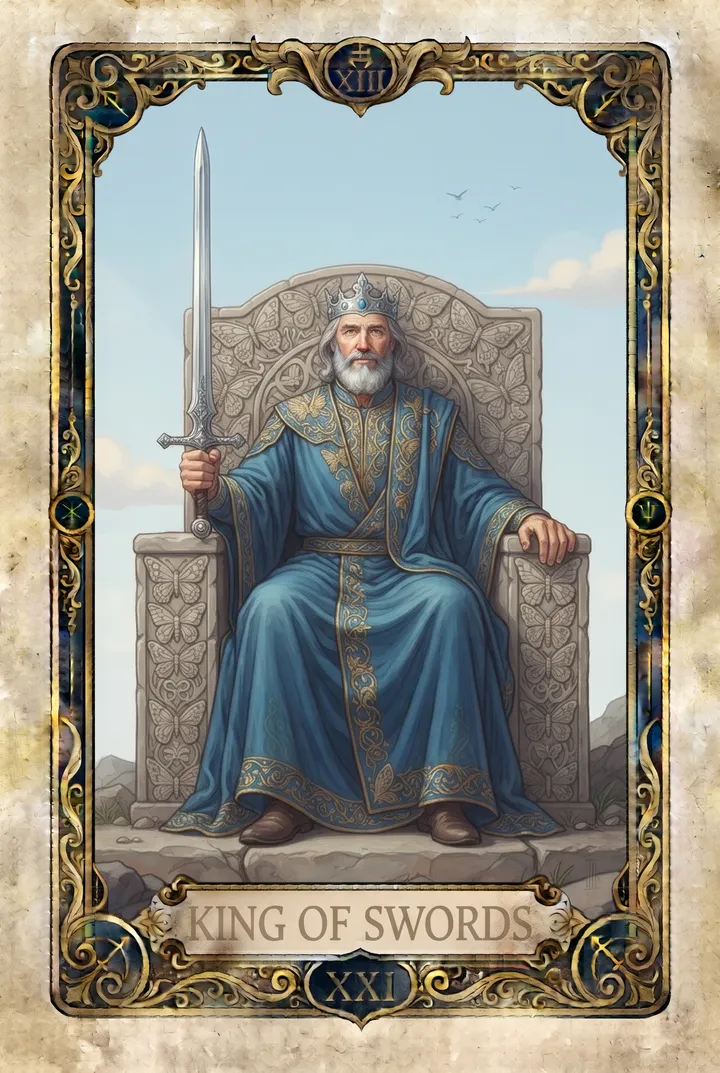
What it means
The King of Swords is a Minor Arcana court card that represents mature thinking, clear boundaries, and authority based on reason. In the suit of Swords, which belongs to the element Air in Tarot tradition, this king stands for the part of you that names the problem, weighs the facts, and speaks plainly. As rank 14, he sits near the top of the court structure, so his energy is less about impulse and more about command, perspective, and steady judgment.
In a reading, he can describe a person, a role, or a way of handling a situation. You might see him when you need to write the email that says exactly what you mean, sit through a difficult meeting without losing your point, or make a decision after too many opinions have blurred the issue.
History and tradition
In traditional Tarot, the court cards are often read as people, personality styles, or stages of maturity within their suit. The King of Swords belongs to the intellectual, verbal, and strategic side of the deck, so teachers of the tradition often connect him with law, analysis, discipline, and the use of words as tools. The suit of Swords itself is associated with Air, which brings ideas, movement, debate, and mental clarity.
Readers often describe this king as someone who values truth, structure, and fair standards. He is the person who notices the loophole in a contract, spots the weak point in an argument, or insists that everyone follows the same rules at the table. In symbolic reading, he is not warm by default, but he is usually clear, and that clarity can be useful when emotions run high.
How to read it
- Notice the first impression. Ask yourself whether the card feels like a person, an attitude, or a decision. In a work issue, it may point to a manager, a lawyer, an editor, or your own need to be precise.
- Look at the surrounding cards. The King of Swords can sharpen them. With emotional cards, he can suggest cooler judgment. With confusing cards, he can show the need for facts, documents, or a direct conversation.
- Check whether the reading asks for structure or distance. This king often says to separate feeling from fact for a moment, like reading a contract before signing it or writing down a disagreement instead of arguing from memory.
- If you draw him about a person, watch for traits like direct speech, high standards, and a preference for logic over drama. He may be fair, but not especially soft.
- If you draw him about yourself, ask where you need cleaner boundaries, stronger language, or a more decisive plan. Sometimes he asks for less explaining and more clarity.
Meanings and key points
One key meaning of the King of Swords is authority through thought. This is the colleague who can run a meeting, the teacher who sets firm rules, or the friend who says, “Let’s look at what actually happened.” In everyday life, this card shows up when you have to choose a clear answer instead of staying in a messy grey area. It can also describe the relief of finally putting a name to a problem.
In love, upright, he often points to honesty, clear agreements, and a relationship that works better when both people speak directly. That can look like two adults discussing plans without hinting or guessing, or one person who values loyalty and mental respect above grand displays. Reversed, he may show coldness, criticism, or a habit of using smart words to win instead of connect. In a real evening, that might look like a sharp reply over a text message, or someone who keeps correcting details while missing the mood.
In work, upright, he suggests strategy, expertise, and the ability to make a fair call. He is the manager who reads the brief before the meeting, the editor who cuts what is unnecessary, or the researcher who trusts evidence over noise. Reversed, he can point to poor judgment, harsh communication, or a person who sounds convincing but is not actually being careful. Think of a rushed decision, a confusing policy, or an argument where nobody is listening to the answer because everyone wants to be right.
Questions to ask yourself
- Where do I need to say what I mean, without softening it too much?
- Am I looking for truth, or just trying to win the argument?
- What decision gets easier if I write down the facts first?
- Where could a firmer boundary save time and stress?
Good to know
Tarot is a symbolic and reflective tradition, not a scientific method for predicting events. Readings can be useful for insight, language, and perspective, but they do not replace legal, financial, medical, or mental health advice when you need expert support. With the King of Swords, the value lies in reflection, not in treating the card as a fact machine.
Frequently asked questions
What does the King of Swords mean in a Tarot reading?
It usually points to clear thinking, honest communication, rules, and fair judgment. The card often shows a person or approach that relies on logic, direct speech, and careful decision-making rather than emotion or guesswork.
Is the King of Swords a good card for love?
It can be, especially when a relationship needs honesty, boundaries, and mature conversation. In readings, it often suggests respect and clarity, but if reversed it can point to coldness, criticism, or emotional distance.
What is the King of Swords in Tarot associated with?
Traditionally, it belongs to the suit of Swords and the element Air. That links it with thought, language, analysis, and strategy, plus the kind of authority that comes from clear judgment and good timing.