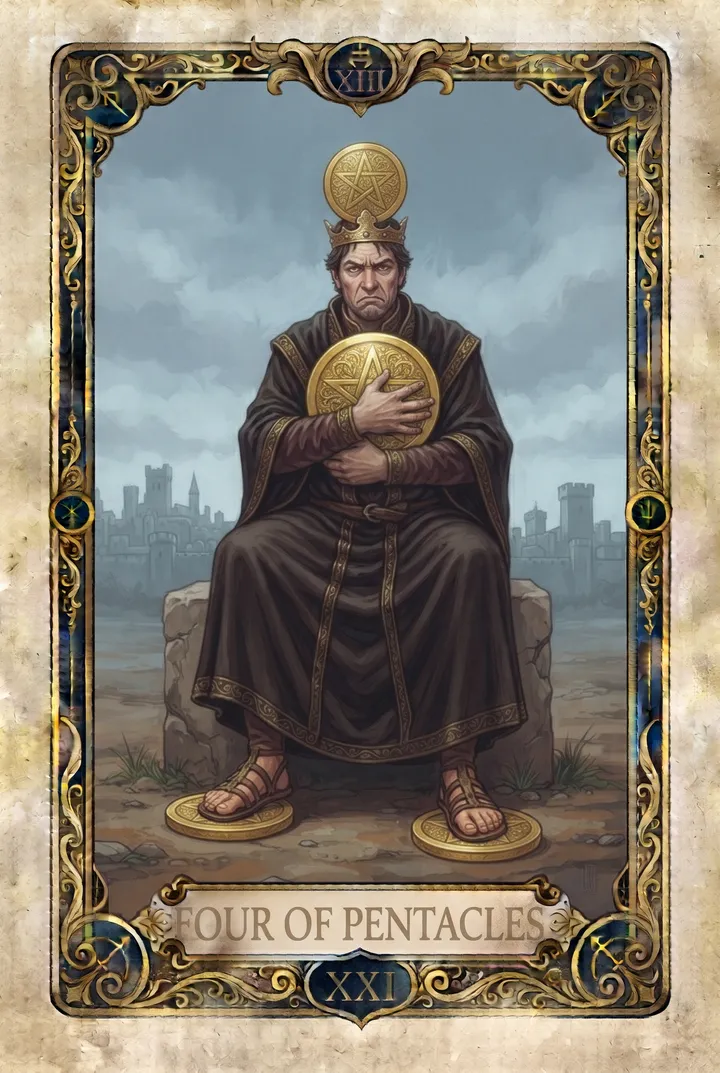
What it means
The Four of Pentacles is a Minor Arcana card in the suit of Pentacles, linked in tradition to Earth, material concerns, and the practical side of life. At rank 4, it often shows a person focused on keeping things steady, safe, and contained. In a reading, it can point to money, savings, routines, boundaries, or the need to protect your space. It can also describe the feeling of gripping something so tightly, like a paycheck, a plan, or a private worry, that your hands are too full to take the next step.
This card is not only about greed. It can also show caution, discipline, and a sensible desire to avoid chaos. The key question is whether your hold is helping you or limiting you.
History and tradition
In tarot tradition, Pentacles belong to the material world, which includes work, property, daily duties, and the body’s need for stability. The Four of Pentacles is usually read as a card of retention, protection, and control. Readers often connect it with someone who wants firm ground under their feet, sometimes after a period of uncertainty or loss.
Because tarot developed as a symbolic system rather than a fixed set of facts, the card’s meaning comes from the suit, the number four, and the scene the deck presents. Four often suggests structure, order, and containment. In practice, that can feel like locking the door twice before bed, checking the bank balance, or saying no to spending when you know the month is already tight. The tradition asks whether security has become rigidity.
How to read it in a tarot spread
- Look at the question first. If you asked about money, the card may point to saving, guarding resources, or fear-based spending. If you asked about work, it may show a cautious approach, keeping your position, or resistance to change.
- Notice what is being held. Is it cash, time, status, privacy, or a fixed idea? The card often reflects what you are clinging to most tightly in daily life.
- Check the surrounding cards. Nearby Pentacles often keep the reading practical, while Cups, Swords, or Wands can show where emotion, thought, or action is being restricted.
- Read the tension. Upright, the card usually suggests control, conservation, boundaries, and possession. Reversed, it can point to looseness, spending, release, or the fear of losing control.
- Bring it back to real life. A closed laptop, an untouched savings account, a drawer full of things you never use, or a schedule packed so tightly there is no room to rest are all simple Four of Pentacles images.
Meanings and key points
Upright
Upright, the Four of Pentacles often means caution, saving, and keeping what you have. In love, it can show someone who is careful with feelings, slow to open up, or protective of personal space. You might know this feeling if you share a flat and still keep one drawer untouched, or if you want reassurance before you speak honestly.
In work, the card can suggest holding onto a job, budget, or position because stability matters more than risk. It may also show someone who is reluctant to delegate, spend, or change a system that still works. Think of the manager who keeps every receipt in neat piles, or the freelancer who says no to a risky project because the rent is due. The strength here is steadiness. The shadow is fear of letting life move.
Reversed
Reversed, the Four of Pentacles often points to release, looseness, or the need to stop gripping so hard. In love, that can mean opening up, sharing more, or letting a relationship breathe instead of measuring every word. It can also show the stress that comes from guarding yourself too much.
In work, reversed may suggest spending too freely, underpricing your effort, or dropping a control pattern that is no longer useful. Maybe you finally clear out the desk drawer, stop saving every broken cable, or admit that the budget needs a reset. The reversed card can also warn against carelessness, but its main lesson is balance. Security matters, yet life gets cramped when everything must stay fixed in place.
The number four and the Earth suit
The number four in tarot is about structure, walls, foundations, and the things that hold a life together. Earth adds the practical side, so this card often appears when you are thinking about rent, savings, a reliable routine, or the safety of having enough. It is the card of the locked box, the organized shelf, and the instinct to keep what is yours.
In everyday terms, that can look like refusing a last-minute dinner because you are watching your budget, or keeping your weekend fully unscheduled because you need recovery time. The card reminds you that structure can support you, but it can also become a cage if you never loosen your grip.
Questions to ask yourself
- What am I trying to protect right now, money, time, privacy, or my sense of control?
- Where does holding on help me, and where does it make my life smaller?
- Am I saving because it is wise, or because I am afraid to move?
- What would a more balanced use of my resources look like this week?
Good to know
Tarot is a symbolic and reflective practice, not a scientific test of facts. The Four of Pentacles can be a useful mirror for your habits and fears, but it does not predict money, work, or relationships with certainty. If a practical problem needs professional help, such as financial planning or legal advice, a tarot reading should not replace it.
Frequently asked questions
What does the Four of Pentacles mean in a tarot reading?
It usually points to holding on, protecting resources, and wanting security. That can be wise budgeting or careful boundaries, but it can also show fear of change, possessiveness, or clinging too tightly to control.
Is the Four of Pentacles a yes or no card?
It is usually read as a cautious yes, or a yes with conditions. The answer often depends on whether you are acting from stability and planning, or from fear and refusal to move forward.
What does the Four of Pentacles mean reversed?
Reversed, it often suggests release, looseness, or a need to stop gripping so tightly. It can point to sharing more, spending less defensively, or letting go of a control habit that is no longer useful.